






Learning the backstitch: complete technique explanation for cross-stitch
You've finished your entire cross-stitch project — hundreds of hours of X's — and then there's one more step on the pattern: 'backstitch.' Those thin, continuous lines that provide contours around eyes, letters, and details. This is where your work goes from flat to sharp.
What is backstitch?
Backstitch is an embroidery technique where you create a continuous line by stitching back one step each time. The result: an unbroken, neat line that is perfect for contours, text, eyes, whiskers, and all the details that cross-stitches cannot create.
When do you use backstitch in a pattern?
In almost every modern cross-stitch pattern, backstitch lines are indicated as thin, continuous lines on the grid — unlike the colored symbols for cross-stitches. Read our article how to read a cross-stitch pattern if these symbols are still new to you.
Backstitch is always done last, after all cross-stitches are complete.
Materials for backstitch
- 1 strand of DMC floss (not 2, as for cross-stitches — backstitch is thinner)
- Your standard embroidery needle (size 24 for 14ct Aida)
- The DMC color indicated by the pattern (often darker than the surrounding cross-stitches)
The backstitch technique step-by-step
- Bring your needle up through point B (one square further than your starting point)
- Stitch back to point A (one square back, your starting point)
- Come up through point C (two squares beyond point B) 4. Stitch back to point B 5. Repeat: come up one square further, go back to the previous stitch
The result: a continuous unbroken line where each new stitch touches the previous one.
Tips for neat backstitch
1. Don't pull too tight
Many beginners pull backstitch too tight — this causes the Aida to pucker. Pull so that the stitch is taut but the fabric surface remains flat.
2. Follow the indicated lines precisely
Backstitch often follows the edge of a colored square, not always through the center. Study the pattern carefully before you start.
3. Diagonal backstitch
Sometimes backstitch runs diagonally. You use the same technique, but through the corner-to-corner points of the square.
4. Long backstitch lines
Keep each stitch a maximum of 2 squares long. Longer stitches look less neat and can break.
Common mistakes
- Using 2 strands: Too thick, looks heavy. Always use 1 strand.
- Working with knots: Hide your starting point under a cross-stitch on the back. Knots are unsightly and can come undone.
- Doing backstitch before cross-stitches: Backstitch gets distorted if you cross-stitch over it. Always do it last.
Examples where backstitch makes a difference
- Faces: Eyes, nose, mouth — only recognizable through sharp backstitch contours
- Text: Cursive names, quotes, years — impossible without backstitch
- Whiskers and hairlines: Essential for animal portraits
- Flower stems and leaf veins: Subtle details that bring the design to life
What if the backstitch comes out?
Backstitch can come loose with intensive washing. Tip: carefully hide the start and end points behind other stitches, and treat the work according to our Aida washing guide.
Further learning
Backstitch is the first step towards more advanced embroidery techniques. After that, you can experiment with French knots, half cross-stitches, or even mixed techniques. You can revisit our beginner's starting guide anytime.
Practice backstitch on a good pattern
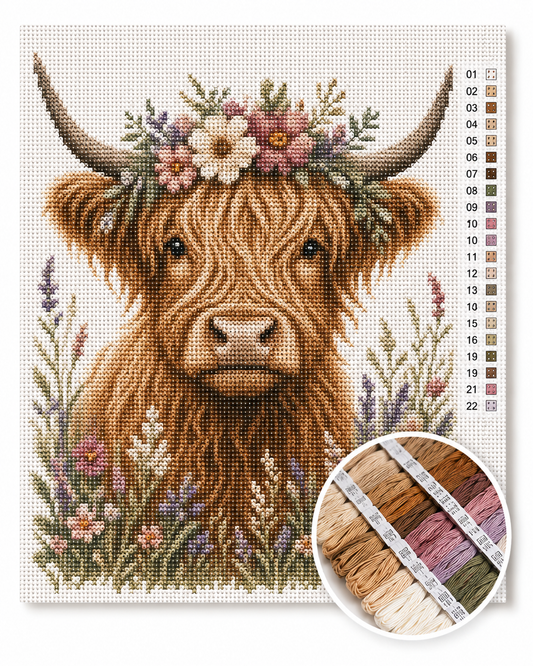
The best way to learn backstitch is on a pattern that actually uses it. Our custom photo embroidery kits typically include backstitch lines for contours around faces and details — perfect for practicing the technique on a project that is already personal. For classic designs with clear backstitch sections, check out our ready-made designs.
Frequently asked questions
How many strands of DMC floss for backstitch?
1 strand (out of the 6 in a DMC skein). This creates a fine, sharp line.
Can I do backstitch in a different color than the cross-stitches?
Yes, follow the exact DMC number indicated by the pattern for the backstitch — often a darker or contrasting color.
When do I do backstitch — before or after washing?
Before washing. Backstitch is part of the work and should be washed along with it.Is there a simpler alternative to backstitch?
Not really — backstitch is already the simplest contour technique. Some beginners try cross-stitches in thin lines, but it never looks as neat.