






Pre-printed embroidery kit (no-count cross-stitch): when is this better than a counted cross-stitch pattern?
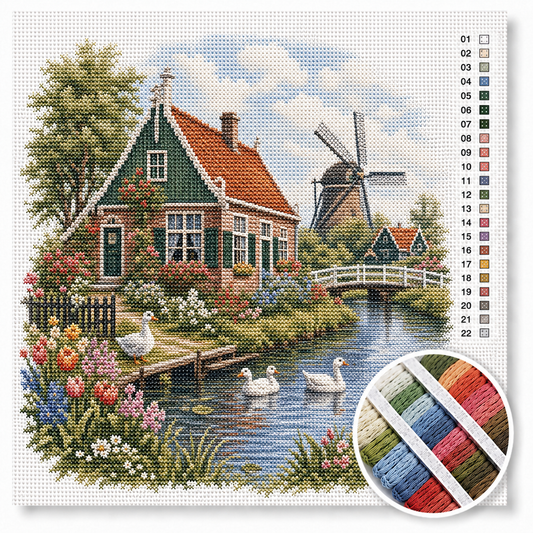
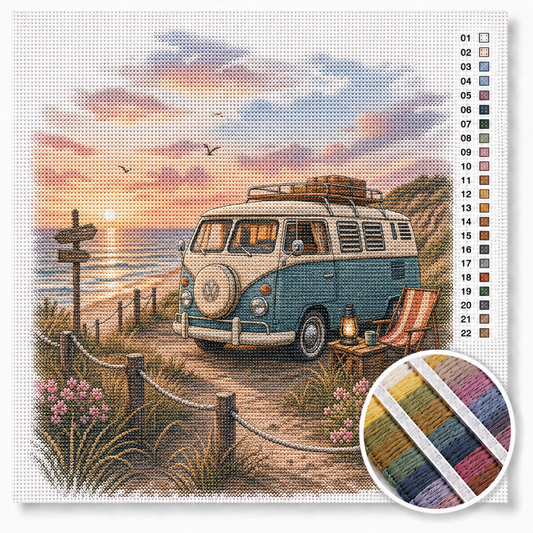
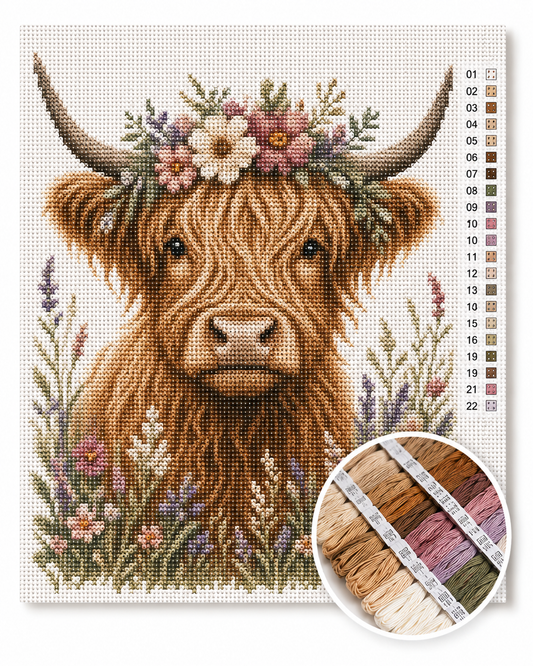
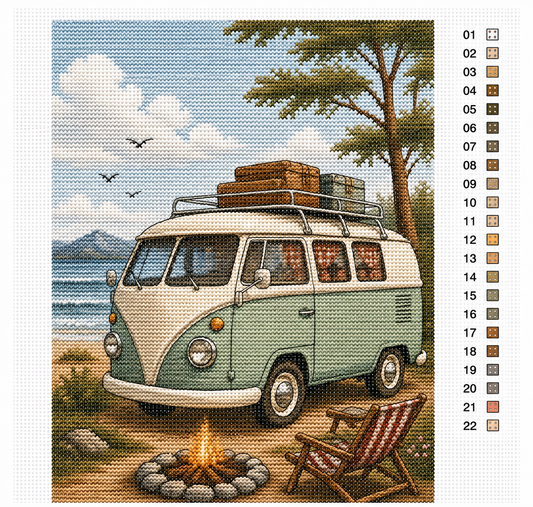
For those who want to learn cross-stitch but are afraid of 'counting', there is an alternative: the pre-printed cross-stitch kit. The fabric comes with the complete pattern already printed on it — each cross has its own colored square. You no longer have to count, no longer have to look at a paper, just stitch in the indicated color per square. In English, this is called stamped cross stitch or no-count cross stitch.
Sounds perfect for beginners. But is it really? In this article, an honest comparison with the classic counted cross-stitch pattern, plus when to choose which type.
What exactly is a pre-printed cross-stitch kit?
With a traditional cross-stitch kit, you get blank Aida fabric plus a paper pattern. You count squares and "translate" symbols on the pattern to spots on your fabric. With a no-count kit, that step is skipped: the manufacturer has printed the complete design directly onto the fabric, often in color. Each square shows which floss color should go in it.
The Aida is usually treated with ink or printed with a stencil. After stitching, the colored areas become invisible (they are under your crosses) or you wash them out with water.
Advantages of a pre-printed cross-stitch kit
- No counting. This is the big selling point. You can't "miscount" — each square is literally marked.
- Lower barrier to entry. For children, people with dyslexia, or anyone who gets nervous from a counted pattern, this is a much more accessible starting point.
- Less tiring for the eyes. You don't have to constantly switch between the pattern and the fabric. Everything is on one flat surface in front of you.
- Quick start. No need to find the center, no folding — just pick up the needle and start.
- Error-proof. If you miss a square, you see it immediately — a color is simply missing from the design.
Disadvantages that manufacturers don't tell you
1. Limited availability
Pre-printed kits mainly come in a fixed range of 'classic' designs: flowers, animals, religious motifs, children's patterns. Do you want a specific photo, a modern minimalist design, or something personal? No-count is rarely possible then.
2. Fabric quality is often lower
Printed Aida is usually a stiffer, rougher fabric because the ink wouldn't adhere otherwise. The end result feels less fine than classic Aida 14ct or 16ct. For wall art that you frame, that's not a problem, but for pillows or heirlooms, you'll notice the difference.
3. The ink can leave a shadow
With some cheaper pre-printed kits, a faint imprint remains visible between your crosses after washing. This is not a problem if your work is densely stitched (all squares filled), but with designs with an empty background, it can be distracting.
4. The result is less sharp
A printed square is always slightly larger than a real Aida cell. As a result, colors in printed kits sometimes bleed slightly outside the lines and the work looks less neat than a counted pattern on blank Aida.
5. You don't truly learn cross-stitching
Honestly: with a counted pattern, you develop pattern reading skills and spatial awareness that you will need for future projects. No-count skips that. If you want to stitch larger and more complex projects later, you will still have to learn to count.
When is pre-printed the better choice?
- For children aged 6-7 and older. Counting is too abstract for that age; colored squares work much better. Also read our guide on cross-stitching with children.
- For people who have never embroidered before and are afraid of giving up. No-count eliminates the "oh no" reaction in the first 10 minutes.
- For reduced vision or macular degeneration. Being able to directly see where each cross should go, without reading glasses or counting strain, makes it accessible.
- For gift kits where you don't know if the recipient will even dare. A lower threshold = a greater chance that the kit will actually be stitched.
When is a counted cross-stitch pattern better?
- For your own photo or personal design. Photo conversions are always counted — see our custom photo cross-stitch kits.
- For larger projects (larger than 30×40 cm). Printing techniques fail for large formats — counted is unbeatable there.
- For modern, minimalist or photorealistic designs. The vast majority of modern designs are only available as counted patterns.
- For those who want to learn and grow. Counted pattern skills are transferable to any future project.
- For maximum final quality. Counted on blank Aida gives a neater, more professional result.
The hidden alternative: a gridded fabric
An intermediate form that is rarely written about: Aida with a marked grid. This has light grid lines on the fabric every 10 squares. It is not a completely pre-printed pattern, but it makes counting much easier. The lines disappear after washing.
This is a golden middle ground for many beginners: the creative freedom of counted, with the comfort experience of no-count.
Comparative table
| Aspect | Pre-printed (no-count) | Counted pattern |
|---|---|---|
| Beginner-friendliness | Very high | High (with good guide) |
| Available designs | Limited, often classic | Endless, also custom photo |
| Fabric quality | Often coarser | Aida 14ct or better |
| End result | Good, sometimes less sharp | Neat, professional |
| Price | Often cheaper | Comparable to slightly higher |
| Custom photo possible? | No | Yes |
| Suitable for 30×40 cm+ | Limited | No problem |
Our choice at Stitchly Studio
At Stitchly Studio, we work exclusively with counted patterns on quality Aida 14ct or 16ct. This is a conscious choice: only counted makes custom photo conversions possible, gives a sharper end result, and is suitable for the sizes our customers usually work with (30×40 to 50×70 cm). Our kits therefore always include a clear pattern explanation and a complete starter guide for anyone who has never read a counted pattern before.
Still in doubt? Also read embroidery set vs embroidery kit and starter kit vs custom kit.
Frequently asked questions
Is pre-printed Aida fabric less durable?
Not by definition, but the printing adds a chemical layer. Well-washed kits last 30+ years, comparable to counted. With cheaper kits, the ink may fade or become transparent sooner.
Can I wash a pre-printed kit?
Yes, but test a corner first. Some inks dissolve in water (which is the intention), others remain and need to be removed with a chemical cleaner. Always follow the specific washing instructions of the kit.
Do you have pre-printed kits in your range?
No. We work exclusively with counted on quality Aida because it makes custom photo conversions possible and gives a neater end result. For absolute beginners who don't want to read a counted pattern, you can buy pre-printed kits at Hobby Gigant, Art en Hobby, or Bol.com.
What age is pre-printed embroidery suitable for?
From about 6-7 years old. Children younger than that are better off starting with plastic canvas or non-cross-stitch crafts.
Is 'stamped cross stitch' the same as no-count?
Yes. Stamped cross stitch, no-count cross stitch, and pre-printed embroidery are synonyms — different names for the same principle.