






Custom Pet Portrait Cross Stitch: The Complete Guide to Stitching Your Dog or Cat
For anyone who lives with a dog or cat, the animal isn't a “pet” — it's family. A four-legged friend who understood your weird days without ever needing to be told. That's why the pet-gift category has exploded over the past decade. But somewhere between the mugs with dog photos and the canvas prints sits one gift that hits differently: a hand-stitched portrait in cross stitch.
This guide walks you through how to turn your own pet into a cross stitch kit or PDF pattern, which photos work (and which don't), what size to pick, and — the most tender part — how a stitched portrait functions as a lasting memorial for a pet you've lost.
Why a stitched pet portrait hits different than a canvas print
A photo print of your dog on canvas costs $30 and ships in 24 hours. A stitched portrait costs more, takes weeks, and is genuinely one of a kind. So what's the actual difference?
- It's made, not produced. Every one of the thousands of tiny X's was placed by a human hand. That gives the work a weight a printer can never add.
- It becomes a family heirloom. A well-made cross stitch hangs for 50+ years. A canvas print fades or yellows within 10.
- It's captured, not recorded. Translating a photo into a grid of stitches produces a painterly quality — as if someone painted your dog rather than photographed him.
- It can be a process. Stitching yourself — or having a family member stitch — is grief or love passing through your fingers. Many people find this surprisingly therapeutic.
Which photo of your pet works best?
Not every photo becomes a beautiful stitched portrait. Here's what works — and what doesn't.
Lighting
Daylight is the best friend of a great pet portrait. Photos taken by a window or outside on an overcast day give soft shadows that let the fur show texture and depth. Avoid:
- Flash photos (flat eyes, unnatural eye glow)
- Midday direct sun (blown-out white spots in the fur)
- Strong backlight (silhouette of your dog, no detail)
Angle and eye contact
A photo where your pet is looking at you always hits harder than a profile shot. The eyes carry 80% of the emotional impact in any pet portrait. Working with a dog? Get down to eye level and wait for the look. Working with a cat? Patience, treats, and good light.
Distance and framing
For a head shot: fill the frame with the face. For a head-and-shoulders portrait: leave 30% of the frame for the chest and shoulders. For a full body shot: enough room around the pet plus context (a bed, the floor, the garden).
Resolution
Minimum 1500×2000 pixels. Lower gives grainy results in the final pattern. Photos from a modern iPhone or Android are almost always sufficient.
Background
A messy background (cluttered bedroom, backyard full of toys) gets translated by the algorithm into blotchy color fields. Ideal: a calm background. A wall, a plain blanket, the grass, the sky. A blurry background also works — it produces a nice soft-focus effect in the finished piece.
Photos that work
- Your dog looking at you, sitting on a plain floor, window light
- Your cat curled up on a colorful blanket, sleepy gaze at the camera
- Two pets together, both faces visible, in a garden
Photos that don't work
- Shots from the back or top-down with the pet curled away
- Hiking photos with sweeping nature + small pet in the middle
- Heavily Instagram-filtered photos with shifted colors
- Screen captures of videos (low resolution + motion blur)
What size fits which type of portrait?
The size of your cross stitch portrait directly determines how much detail is possible and how many stitching hours are required.
| Size | Portrait type | Stitch time | Wall presence |
|---|---|---|---|
| 20×25 cm | Mini, head only | 20–30 hours | Lovely on a small wall |
| 30×40 cm | Head and shoulders | 60–80 hours | Recognizable from 1–2m |
| 40×50 cm | Half body or small full body | 100–150 hours | Statement piece from 3m |
| 50×70 cm | Full body or large head | 200–300 hours | Gallery wall, year-long project |
My recommendation for most people: 30×40 cm or 40×50 cm. 30×40 is an honest project (8–12 weeks at 1 hour/day), 40×50 becomes a statement piece. More on size choices in our cross stitch pattern sizes guide.
From photo to pattern: what happens behind the scenes
When you upload a photo to a custom photo cross stitch kit, your image runs through several steps:
- Pixel analysis. The algorithm examines each pixel and sorts them by color.
- DMC translation. Each color is matched to the nearest DMC floss number. Typically 40–80 different flosses for a dog or cat portrait.
- Grid conversion. The pattern gets its squares — one cell per stitch.
- Backstitch detection. Lines for eyes, whiskers, and contours are marked as backstitch.
- Legend generation. Each symbol gets its place in the legend.
- Material bundling. The kit gets assembled: Aida fabric in the right size, exact DMC flosses in proper quantities, needle, hoop, pattern and starter guide.
If you'd rather only buy the pattern, you can grab the PDF pattern alone — you supply your own floss and fabric. Faster, cheaper, and useful if you already have a well-stocked floss collection.
No perfect photo? Pick a ready-made portrait that resembles your pet
Not everyone has a great photo of their pet — especially for older dogs or animals that aren't with us anymore. In that case, a ready-made portrait that resembles the animal can be the best alternative:
- Golden Retriever 'Buddy' — for anyone with (or who had) a blonde retriever
- Dachshund with Scarf — for the sausage dog fan
- Kitten with Flower Crown — for sweet-cat lovers
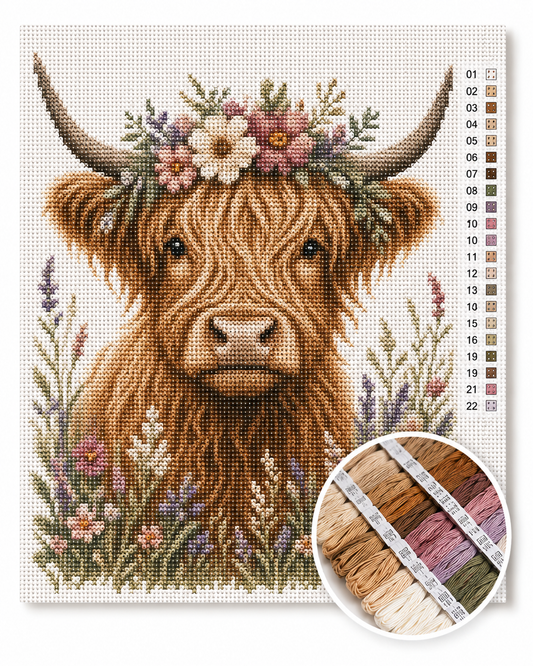
- Highland Cow with Flowers and Classic Highland Cow — not technically a pet, but adored
The full catalogue is in our ready-made cross stitch kits collection.
How long does a pet portrait take to stitch?
Honest averages:
- 30×40 cm portrait (90% stitched coverage): 60–80 hours. That's 8–10 weeks at 1 hour/day, or a few focused weekends.
- 40×50 cm portrait: 100–150 hours. 3–4 months at 1 hour/day.
- 50×70 cm portrait: 200–300 hours. A large project running 6–9 months.
Faster stitching is possible: after 2–3 projects an average stitcher hits 150–200 stitches per hour instead of the 80–100 a beginner manages. But be honest: pet portraits are detail-heavy and demand patience.
For which gift moments does a pet portrait work?
Birthday of a pet owner
The classic. Works especially well if you don't have a direct bond with the pet owner — sisters-in-law, nephews, old friends. A stitched portrait of their pet shows you know what matters to them.
For your partner
Tip: have the same portrait made in 2 sizes — a large for the living room, a small for the desk at work. Costs you no extra pattern work, doubles the impact.
For in-laws after a new dog
When someone's adopted a new pup or kitten, a stitched portrait during those first “honeymoon months” is gold. Tip: take a photo in the first month of adoption and save it for an upcoming birthday or Christmas.
Housewarming
A pet portrait as the first piece of art on the new wall. More personal than a second-hand plant.
Anniversaries
Have your parents shared the same Golden Retriever bloodline for 40 years? A stitched portrait of the current dog is a deeply personal gift. More angles in our anniversary cross stitch guide.
In memoriam: a stitched portrait of a pet who's passed
This is a tender topic — and one of the most common reasons people commission pet portraits. The loss of a dog, cat, horse or rabbit hits many people deeper than they expect. A stitched portrait can function as:
- A ritual. Stitching the work yourself — 60, 80, 150 hours — is grief slowed down and passed through your fingers. Many grieving owners describe the process as therapeutic.
- A permanent object. Unlike a photo in a drawer, a stitched portrait hangs on the wall. The animal isn't tucked away — they're honored.
- A gift to a grieving owner. If someone close to you has lost a pet, a stitched portrait is one of the most emotionally resonant gifts you can give.
Practical tips for memorial portraits:
- Add the pet's name + birth/passing dates as stitched text below or beside the portrait
- Optionally add a short quote (one line maximum — more becomes overwhelming)
- Choose a photo from a good time in the animal's life, not their final days
- Pick a neutral frame color (black, dark wood, off-white) so the work stays central
Stitch it yourself or commission it?
1. Stitch it yourself (you're a stitcher)
Order a custom photo cross stitch kit and get going. Pro: maximum personal meaning, you made it. Con: 60–300 hour time commitment.
2. Give the kit (the recipient stitches)
Hand the kit to someone who loves stitching. Pro: they get weeks of calm evenings to look forward to. Con: you're giving the supplies, not the finished work.
3. Hire a professional stitcher
For those without the time but who want the finished piece: hire an experienced stitcher via Etsy, Instagram (search #crossstitchcommission), or local craft networks. Budget $15–25 per stitching hour — a 30×40 cm portrait runs $500–1,200 commissioned.
What does a pet cross stitch portrait cost?
- PDF pattern only (you supply materials): from $16
- Custom photo kit 30×40 cm including all materials: from $80
- Custom photo kit 40×50 cm: from $125
- Custom photo kit 50×70 cm: from $175
- Commissioned (someone else stitches): $400–1,500 depending on size and stitcher
Tip: for a birthday deadline three months out, order now to give yourself (or the recipient) enough time. Last-minute? Pick a PDF pattern — delivered to your inbox within 24–48 hours.
Finishing: from stitched portrait to wall-ready artwork
Once the work is done, four options:
- Classic framing behind glass. Safest for long-term preservation. See our finishing guide for the steps.
- Mounting on stiff board without a frame. Modern look, lower cost.
- Leaving in the hoop as bohemian wall art. Works well for smaller portraits.
- Turning into a pillow if you want it functional.
Don't forget to gently wash and iron the work first — see our Aida care guide.
FAQ
Does a stitched portrait work for every dog breed?
Yes. Coat colors, coat textures, and eye shapes vary by breed, but the algorithm accounts for this in DMC palette choice. Dogs with very dark coats (like black Labradors) show slightly less texture detail than light-coated breeds.
How far in advance should I order for a birthday?
For a complete kit: minimum 1 week before the birthday. For a stitched-by-you finished portrait: order 3 months out to give yourself 60–80 stitching hours over 12 weeks.
Can you put two pets in one portrait?
Yes, provided there's a photo of both animals together. The composition and resolution of that photo determines the result.
Does it work for horses, rabbits or birds?
Absolutely. Horse portraits are huge with riding enthusiasts. Rabbits and guinea pigs have rounder heads and work beautifully on smaller sizes. For birds: parrots and owls translate especially well thanks to their color patterns.
What if my photo isn't perfectly sharp?
Light blur often works in your favor — it produces a painterly effect. Heavy motion blur or focus on the wrong part (e.g. the nose rather than the eyes) is harder. Check our broader guide on photo to cross stitch pattern conversion.
How long does a stitched pet portrait last?
Made well and stored correctly: 50+ years. Avoid direct sunlight and minimize washing — your grandchild will still be discovering the picture of grandma's dog on the attic.
What if I'm in active grief and can't bring myself to stitch yet?
Wait. Order the pattern and store it. Many owners only start 3–6 months after losing their pet. That's okay. The work will wait.
Ready to start?
The simplest start is a custom photo cross stitch kit with your favorite pet photo. Want just the pattern? Grab the PDF pattern. Want a ready-made design that resembles your pet? Browse our complete kit collection.
Still on the fence about size or photo choice? Email us at info@stitchlystudio.com with your photo and we'll review whether it'll work and recommend a size. Free advice, no sales pitch.