






Stitching Against Stress: What Research Really Says About Cross-Stitch
In short: Cross-stitching reliably reduces self-reported stress and physiological arousal in studies, largely through the same mechanisms as meditation: focused repetitive attention, slowed breathing, and a flow state. It is not a replacement for therapy or medication, but it is one of the well-documented low-threshold tools for everyday stress. The effect sets in after 10–15 minutes of stitching.
What research shows
- Self-reported stress decreases after 20–40 minutes of cross-stitching or knitting in almost every survey. A frequently cited study by Riley, Corkhill, and Morris (2013, British Journal of Occupational Therapy) showed that 81% of frequent knitters felt happier after a session.
- Heart rate and blood pressure measurably decrease during repetitive needlework, comparable to breathing exercises.
- Flow state (the absorbed, time-forgetting state described by Mihaly Csikszentmihalyi) reliably occurs with pattern-based stitching once basic mastery is achieved.
- Mood improvement lasts hours after a session.
The mechanism is simple: repetitive, attention-demanding handwork displaces brooding thoughts.
Why does cross-stitching work against anxiety?
- Narrow focus of attention. Anxiety thrives in broad rumination; cross-stitching requires focus on a single grid square.
- Predictable rhythm. Every stitch identical. Activates the same parasympathetic response as mantra meditation.
- Visible progress. Anxiety often involves feeling like you're getting nowhere. Every stitch is concrete progress.
- Tactile engagement. Practical activity grounds you in your body.
Compared to other stress reduction tools
- Vs Meditation: Cross-stitching works for people who can't sit with their eyes closed. Same flow state, easier entry.
- Vs Running: Different mechanism (endorphins vs flow), but both reduce baseline anxiety.
- Vs Scrolling: Scrolling is the opposite — broad attention, no progress. Cross-stitching is a cleaner replacement for evening scroll time.
- Vs TV only: TV is passive; cross-stitching is active-quiet. Combining both is ideal.
What you can expect
- First 1–2 sessions: Slight frustration learning to read the pattern. Mild stress relief.
- Sessions 3–5: Pattern reading becomes automatic. Stress relief after 10–15 minutes per session.
- After ~10 sessions: Reliable "my brain switches off" zone on demand.
Patience counts — the first session is the hardest. Persist until session 3.
Optimal setup for maximum stress relief
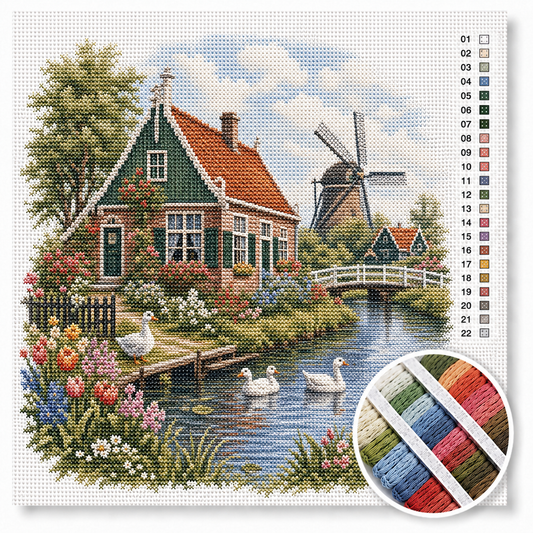
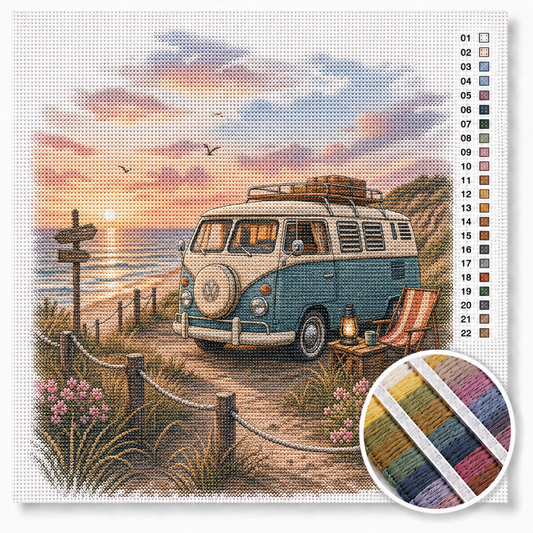
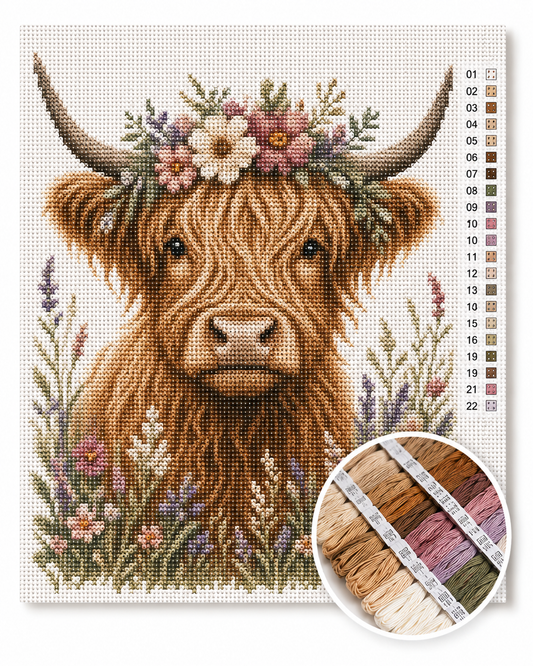
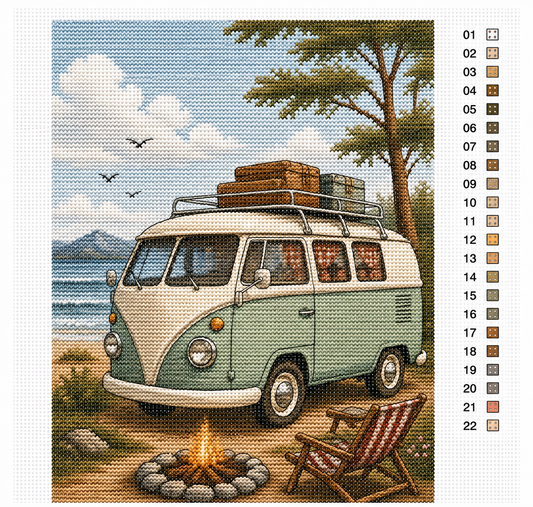
- Visually calming pattern — landscape, animal, botanical. Avoid busy ones.
- 11ct or 14ct Aida — 16/18ct can cause tension.
- Soft ambient audio — instrumental music, ambient. Avoid news or true crime.
- Daylight lamp — Squinting increases stress. Lighting guide.
- A dedicated armchair, not the scrolling spot. Helps the brain associate the place with downshifting.
What it doesn't do
- Does not cure clinical anxiety or depression.
- Does not help if you use it to avoid problems that need solutions.
- Does not work with a frustrating project. Pattern choice matters.
Stitching as an evening reset
Choose a calming landscape, animal, or botanical — as a complete set in 24 hours.
Frequently Asked Questions
Does stitching really reduce stress?
Yes — studies show measurable decreases in self-reported stress and physiological markers (heart rate, blood pressure).
Is stitching better than meditation for anxiety?
Not better — different. Uses the same flow mechanism with easier entry.
When does the calming effect begin?
After 10–15 minutes, once basic mastery is achieved (around session 3).
Which motif is most calming?
Landscapes, animals, botanicals on 11–14ct. Avoid cluttered patterns.
Can stitching replace therapy?
No. It is a daily tool, not a clinical treatment.
Summary
Cross-stitching reduces stress similarly to mindful breathing or meditation — through focused attention, slower breathing, and a flow state — but with an easier entry. Choose a calming pattern, good lighting, and give it three sessions before you judge.