






DMC Color Chart: How to Choose Embroidery Floss Colors
Last updated: 6 May 2026 — by Stitchly Studio
Pull the wrapper off any skein of cross stitch floss and you'll find a number stamped on it — 312, 815, 3826, B5200. That number is its place on the DMC color chart, the world's most-used embroidery floss reference. Once you can read DMC numbers, every pattern, kit, and substitute chart in cross stitch suddenly makes sense. This guide walks through how the numbering works, how to build your own palette, how to store floss so you can find a color in three seconds, and what to do when a pattern calls for a discontinued shade.
The short version
- DMC is a French thread brand, the global reference for cross stitch floss colors.
- Each color has a unique number from 150 to 3895, plus a few special codes (B5200, ECRU, BLANC).
- Numbers are NOT sequential by hue — don't try to guess shades from numbers.
- Anchor and Madeira make near-identical floss; conversion charts exist.
- Store floss on bobbins or in baggies labeled by number, organized in numerical order.
- Buy floss as you need it — don't try to collect all 500 colors upfront.
What is DMC?
DMC (Döllfus-Mieg & Cie) is a French textile company that has been making embroidery thread since 1746. Their 6-stranded cotton floss is the de facto standard in cross stitch — every pattern designer charts in DMC numbers, every kit ships with DMC floss, and every shop carries the line. There are over 500 colors in the current range.
Each skein is 8 meters (8.7 yards) of cotton thread, made of six strands twisted loosely together. You separate the strands as needed: most cross stitch on 14-count Aida uses two strands at a time. The full strand count and floss usage per pattern is in our Aida cloth count guide.
What is a DMC color chart?
A DMC color chart is the master reference showing every available color, its number, and a sample of the actual thread (or a printed approximation). There are three forms:
- Printed booklets. Sold by DMC and craft retailers. The printed colors are close approximations — don't rely on them for exact matches.
- Real-thread cards. Cardboard cards with actual snippets of every floss color. Most accurate, slightly pricier. Worth every cent if you stitch often.
- Digital charts. PDFs, apps, and websites showing colors on screen. Convenient but screens lie about color, especially in the blue-to-purple range.
If you stitch more than a few times a year, get a real-thread card. It's the only way to know whether 826 (medium blue) is the right shade against your Aida fabric color, and it'll save you from ordering wrong colors online.
How to read DMC numbers
The most useful thing to know about DMC numbers: they are NOT logically ordered by color. The first hundred numbers and the recent additions in the 3000s are scattered across the rainbow.
However, some patterns repeat:
- Special codes: BLANC (pure white), ECRU (off-white), B5200 (snow white).
- Color families share groups: 310 is black, 318 to 535 are mostly grays. 200s and 600s lean reddish-pink. 700s lean blue. 900s lean dark.
- Shade variations come in clusters: 310, 311, 312, 322, 334, 336 are all blues from very dark to medium light. But 312 isn't "darker than 313" — always check.
- Newer colors are in the 3000s: 3801 to 3895 are recent additions. They're often the most fashionable shades — dusty rose, sage, mustard.
Don't memorize numbers. Just trust the chart. When a pattern says 826, find 826 on your real-thread card and pull that skein.
Working with the chart on a pattern
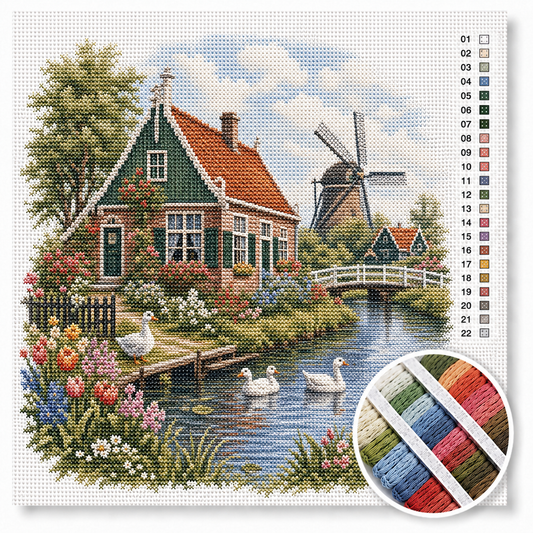
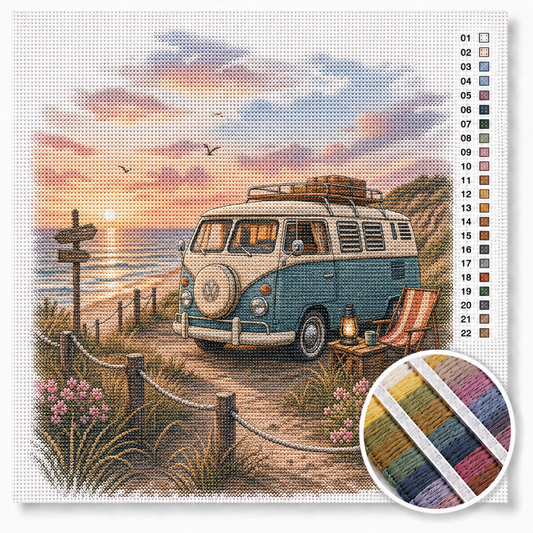
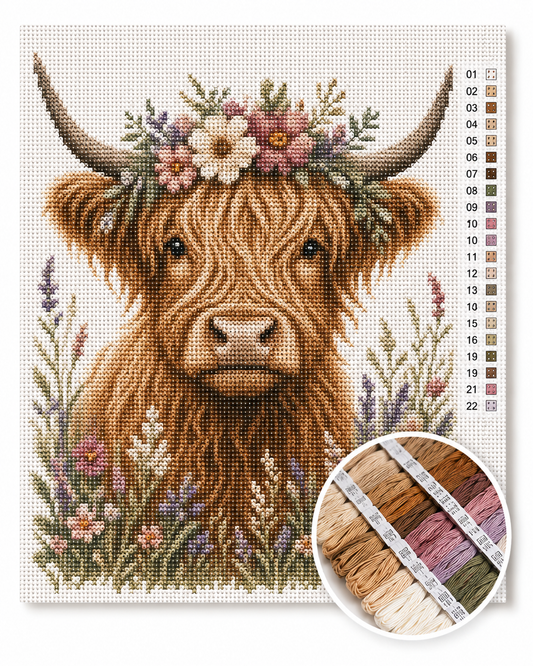
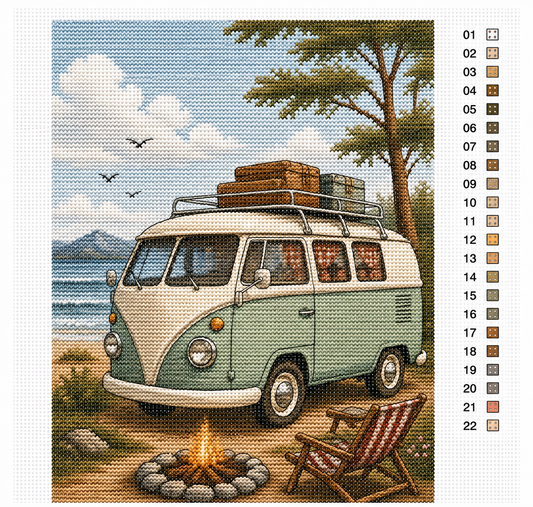
Open any cross stitch pattern legend and you'll see something like:
Symbol    DMC #    Color name        Strands    Stitches
  X       310     Black              2          124
  o       3801    Red, very dark     2          88
  +       BLANC   White              2          410
Pull each skein listed, label it with a small piece of tape (write the number, not just the color name), and group them next to your hoop. Pull only the colors you need for the section you're working on — a tabletop with all 30 colors out at once is asking for confusion.
If you're new to reading patterns, our guide to reading a cross stitch pattern explains the legend, symbols, and how patterns map to fabric.
Building your own color palette
If you're charting your own designs (or substituting colors in someone else's pattern), here are the rules that produce good palettes:
- Limit to 12-25 colors. More than 25 looks busy at small sizes; less than 12 looks flat at large sizes.
- Always include a darkest dark and a lightest light. Without contrast, the piece looks washed out from across a room.
- Pick three to five shades of any one color. One pink looks like a sticker. Five pinks looks like a flower.
- Test on actual Aida. Colors look different on white, ecru, and dark fabric.
- Avoid clashing temperatures unless intentional. Mixing warm beiges (3782) with cool grays (414) reads as muddy.
If charting your own design feels intimidating, our custom photo cross stitch kit handles palette selection automatically — the conversion picks the optimal colors from your photo.
DMC alternatives: Anchor, Madeira, and J&P Coats
Three other brands make cross stitch floss that's effectively interchangeable with DMC:
- Anchor (UK / EU) — the closest match. Conversion charts list DMC-to-Anchor pairs (often within 1-2 shades).
- Madeira (Germany) — also strong. Slightly different shade range; some DMC colors have no exact Madeira twin.
- J&P Coats (US) — budget-friendly. Color range is narrower and slightly less consistent.
If a pattern calls for DMC and you only have Anchor, look up the Anchor equivalent. If you mix brands within one project, do it intentionally — the dye batches differ, and a finished piece with five different floss brands can look patchy under bright light.
Storing floss by number
An organized floss stash saves more time than any other cross stitch tool. The two best systems:
Bobbins in a box
Wrap each skein around a small plastic or cardboard bobbin. Write the DMC number on the bobbin. Store all bobbins in numerical order in a divided plastic box (around 80 to 100 fit per box). Pros: every color visible at a glance, easy to grab. Cons: time investment to wind everything up front.
Baggies in a binder
Drop each skein into a small zip baggie labeled with the DMC number. Punch holes; store in a 3-ring binder. Pros: skeins stay intact, no winding. Cons: bulkier, harder to scan visually.
Whichever you pick: organize numerically, never alphabetically. "Dark blue" lives next to a hundred other dark blues; 824 always lives between 823 and 825.
Frequently asked questions about the DMC color chart
Are DMC colors the same on every chart?
The dye batch is the same, but printed reproductions vary. A printed chart is an approximation — always confirm against a real-thread card or an actual skein before buying online.
Can I substitute a similar DMC color if mine is missing?
Yes, in most cases. Find the closest shade on your real-thread card. The piece will read the same to anyone except you. The only exception is when a pattern uses two close shades for shading — swapping one will flatten the gradient.
What does B5200 mean compared to BLANC?
B5200 is the brightest, whitest white DMC makes — a slightly bluish, snow-white shade. BLANC is a softer, slightly warmer white. They're both "white" but they're not interchangeable in projects where pure brightness matters.
How do I find a discontinued color?
DMC publishes substitution lists when they retire a color. Check the DMC website or any conversion chart. Online stitching forums also keep current lists.
Should I buy a full DMC set?
Probably not. A full set runs hundreds of dollars. Most stitchers build their stash one project at a time — you'll naturally accumulate the most-used colors after 5 or 6 finished pieces.
Ready to start stitching?
Get a real-thread DMC chart, organize your existing floss numerically, and the next pattern will feel half as intimidating. If you'd rather skip floss-shopping entirely, our custom photo cross stitch kit ships with the exact DMC colors pre-counted for your image. Pair this with our cross stitch starter guide and the Aida cloth count guide for a complete supply walkthrough.