






Choosing embroidery needles: the right needle size per aida count and project
Short version: for cross-stitching, use a tapestry needle – an embroidery needle with a blunt tip and a large eye. For 14ct Aida, size 24 is standard; for 16ct or 18ct, go for size 26 or 28. The higher the size number, the thinner the needle. Below, you’ll learn how to choose the right size for your fabric, thread, and project – and the three mistakes that can make your needle dull faster.
Which needle do you use for cross-stitching?
Not just any needle from the sewing box. For cross-stitching, you need a tapestry needle (also known as an embroidery needle or petit point needle). Three characteristics make it suitable:
- Blunt tip — glides between the threads of your Aida instead of piercing them. This prevents you from accidentally stitching through your own cross or splitting fabric threads.
- Large eye — comfortably fits 2, 3, or 4 strands of floss.
- Sized by number — European sizing works in reverse: the higher the number, the finer the needle. Size 24 is thicker than size 28.
A regular sewing needle (sharp or embroidery) actually works against you for cross-stitching: too sharp a tip, too small an eye. Save those for backstitching on fine fabric or for finishing off.
Which needle size per Aida count — overview table
The rule of thumb is simple: the finer your Aida fabric (higher count), the thinner your needle. Otherwise, you’ll stretch the holes and see gaps on the back.
| Aida count | Recommended needle | Number of thread strands | Suitable for |
|---|---|---|---|
| 11ct (coarse) | Size 22 or 24 | 3 strands | Children, beginners, quick projects |
| 14ct (standard) | Size 24 | 2 strands | Most cross-stitch kits |
| 16ct | Size 26 | 2 strands | Slightly finer detail, smaller portraits |
| 18ct (fine) | Size 26 or 28 | 1 or 2 strands | Photo portraits, fine art kits |
| 22ct (very fine) | Size 28 | 1 strand | Petit point, miniatures |
Unsure of your Aida count? Check the label of your cross-stitch kit or read our explanation of 11ct, 14ct, 16ct, and 18ct Aida.
The needle test: does it fit your fabric well?
A quick check: push the needle through a hole in your Aida. It should slide through smoothly without resistance. Two signs that you're using the wrong needle:
- You have to push → needle too thick, choose a higher size number.
- Needle falls through and wiggles → needle too thin, stitches will be messy because you can't aim properly.
John James, DMC or Bohin: does the brand matter?
Honest answer: for beginners, not really. For those who stitch a lot: yes.
- John James (UK) — favorite among stitchers. Narrow eye that glides well through Aida, remains usable for a long time.
- DMC — available at every craft store, good quality, often cheaper.
- Bohin (France) — premium, especially good for high counts (26/28).
- Gold-colored needles — not better, but more visible if you leave them lying among your thread.
Our ready-made embroidery kits come standard with a John James tapestry needle size 24 — sufficient for the entire kit and usable for years afterwards.
Needle size per thread count: a second check
Besides the Aida, the number of floss strands also determines your needle choice. Logic: more strands = thicker bundle = larger eye needed.
- 1 strand (fine details, backstitch) → size 26-28
- 2 strands (standard cross-stitch) → size 24-26
- 3 strands (full effect on 11ct) → size 22-24
- 4+ strands (rare, old kits) → size 20-22
Not sure how many strands you need? In our guide on splitting embroidery floss, we explain exactly when to use 1, 2, or 3 strands.
When is your needle due for replacement?
A good embroidery needle lasts a long time — months, sometimes an entire kit. But they do wear out. Replace it as soon as you notice any of these things:
- The needle feels stiff going through your fabric — coating worn out.
- You see discoloration or a ridge near the eye — your thread will fray.
- The needle has become bent or keeps getting stuck.
- Your thread snags with every stitch — almost always the needle, rarely the thread.
Cheap insurance: buy a pack of six for a few euros and swap it out as soon as it feels stiff.
Three mistakes that unnecessarily quickly ruin your needle
- Sticking the needle into your fabric as an anchor. 'Parking' the needle in the Aida in between seems innocent, but you are constantly stretching the same hole and slightly bending the needle. Park it in the margin or in a pincushion.
- Breaking the thread with your teeth. Classic. Damages the enamel around the needle eye when you pull the thread through your teeth to cut it. Use your scissors.
- Allowing the needle to rust. Finger grease, damp hands, and hours in the same Aida = dots on the needle. Wipe it briefly with a cotton cloth after each session.
Lost needle in your work? Here's how to find it
Every embroiderer has lost one sometime: the needle in the couch, in the carpet, somewhere. Trick: run a strong refrigerator magnet over the fabric or floor. A tapestry needle is made of steel and will immediately jump to it. Also works for needles that have sunk deep into your work.
Which needle is included in a Stitchly Studio kit?
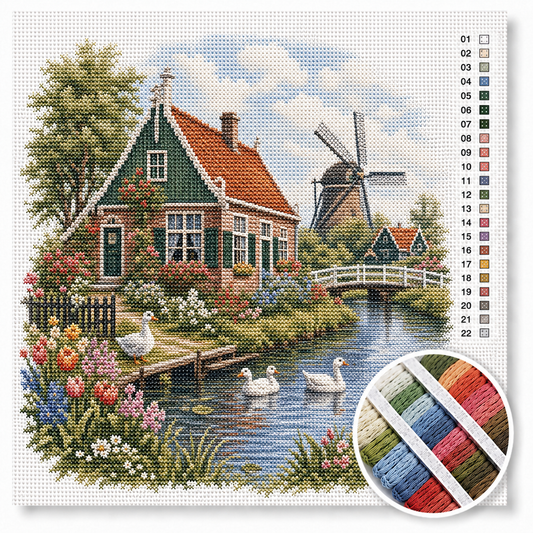
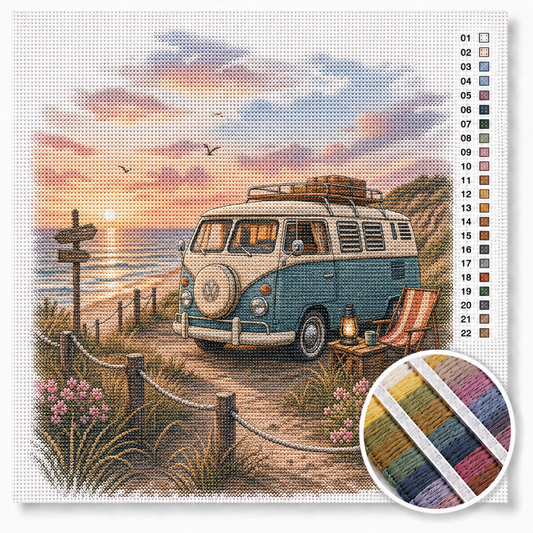
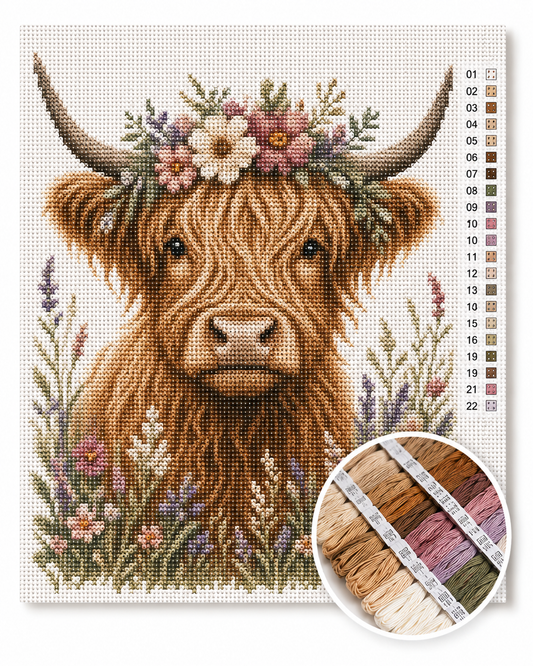
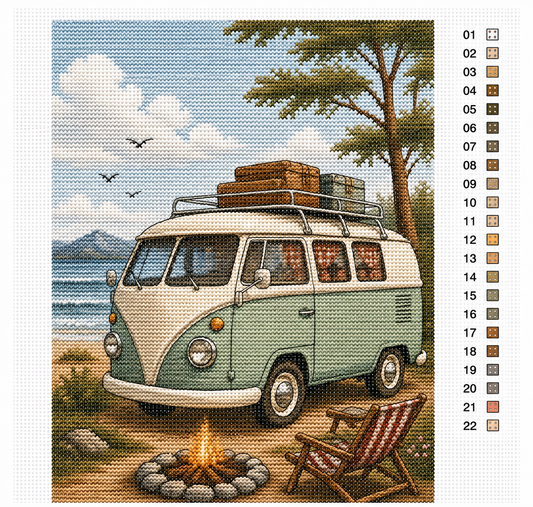
Each of our ready-made designs and the Custom Photo Embroidery Kit comes standard with a John James tapestry needle size 24 — matched to the 14ct Aida we use for most kits. If you prefer to work on a finer count, we mention the appropriate size in the product information.
Frequently asked questions
Can I use a regular sewing needle for cross-stitching?
You can, but it works against you. A sewing needle has a sharp tip that pierces your Aida threads instead of going between them. Result: split threads, crooked stitches, and a hole faster. A tapestry needle is much more pleasant to work with.
What is the difference between a tapestry needle and a chenille needle?
Almost identical in size and eye, but the chenille needle has a sharp tip. For cross-stitching on Aida, you want the blunt tip of a tapestry needle. Chenille is for embroidery on regular fabric (like embroidering on linen clothing).
Which needle for backstitch?
For backstitch on Aida, use the same tapestry needle, but preferably one size thinner than for your cross-stitches. If you're working on 14ct with size 24, use a size 26 for backstitch — finer detail, prettier result. Also read our backstitch technique explanation.
How many needles do I need for one kit?
One good tapestry needle usually lasts an entire kit — even for large designs of 40x50 cm. Keep an extra one handy in case you lose it.
Can an embroidery needle go in the washing machine?
No. Always remove your needle from your work before washing it (see our Aida washing guide). The needle will rust, and if it gets caught in a fold, it will poke holes.
Ready to start?
Don't want to start with loose needles, thread, and fabric? A Stitchly Studio embroidery kit contains everything you need — including the right needle for your fabric. Or make it personal with a custom photo cross-stitch of your dearest memory.